


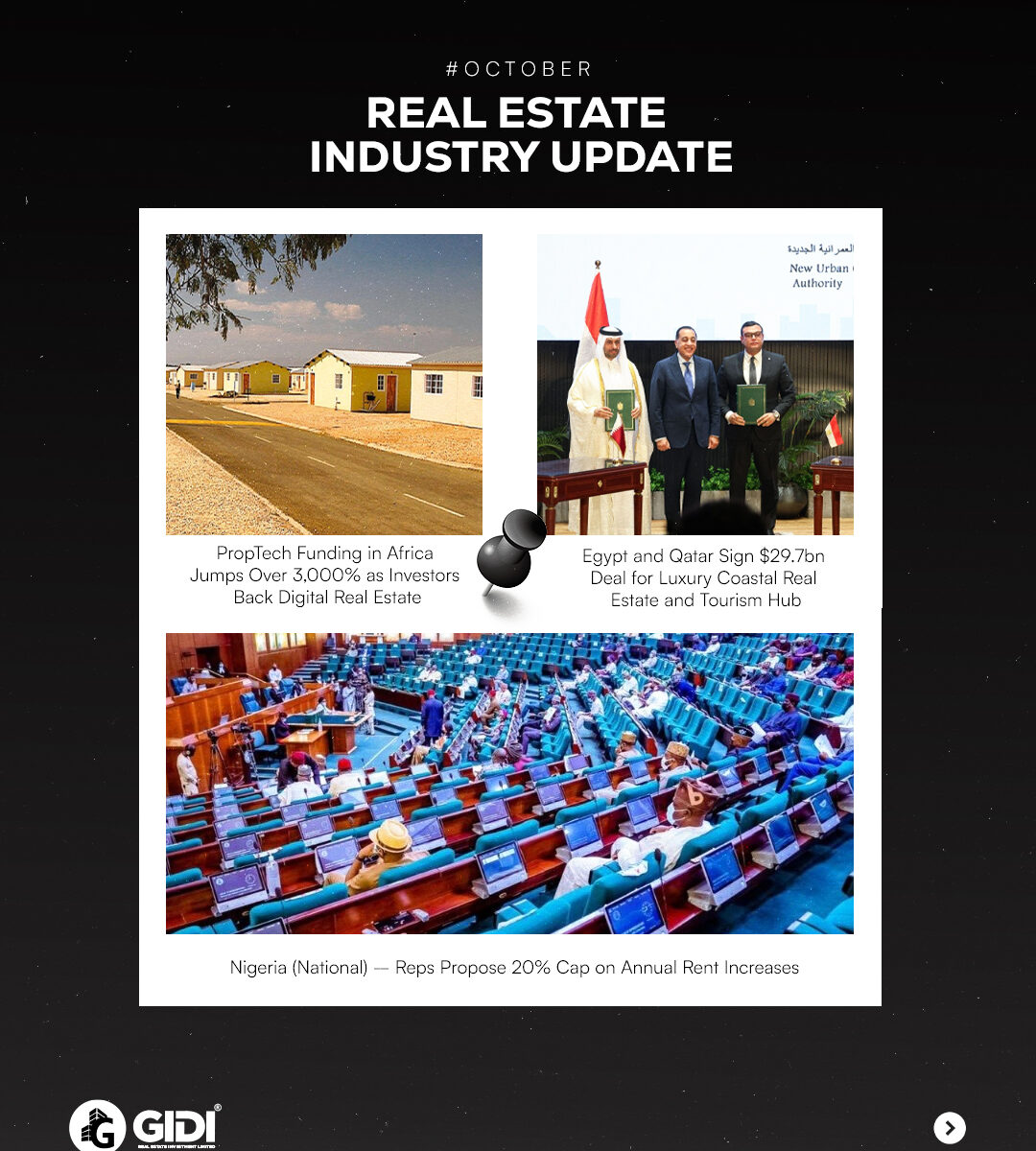
1. PropTech Funding in Africa Jumps Over 3,000% as Investors Back Digital Real Estate
Recent data from TechCabal Insights shows that PropTech startups in Africa raised about $75m in H1 2025, a jump of roughly 3,650% from about $2m in the same period last year. Much of this is concentrated in platforms that digitise property search, verification, financing, and transaction flows.
One example on the Nigerian side is ULÉ Homes, a Lagos-based proptech startup that won TechCabal’s Moonshot 2025 Startup Battlefield, securing $10,000 in prize money and negotiating up to $400,000 in investment to scale its housing-access platform.
Why it matters:
Confirms that technology and real estate are now mainstream funding territories in Africa, especially in Nigeria.
2. Egypt and Qatar Sign $29.7bn Deal for Luxury Coastal Real Estate and Tourism Hub
Egypt and Qatar have signed a partnership to build “Alam Al-Roum”, a luxury real estate and tourism project on Egypt’s Mediterranean coast. The project spans about 7km of coastline and is led by Qatari Diar, with a total investment projected at $29.7bn.
Qatar will pay $3.5bn in December 2025 for the land, money Egypt plans to use as fresh FDI to ease debt and stabilise economic indicators. The project will feature golf courses, marinas, and housing units, with Egypt also receiving units valued at $1.8bn plus 15% of profits once costs are recovered.
Why it matters:
Illustrates how large mixed-use coastal projects are being structured in Africa (equity, profit share, and housing components).
Useful benchmark for seaside or tourism-linked projects open for exploring across Africa.
Strengthens your internal story that Africa’s real estate is increasingly tied to regional capital flows and sovereign funds, not just local investors.
3. AfRES Warns Inadequate Data in Nigeria’s Real-Estate Sector Hinders Housing Finance and Sustainable Growth
Key consequences include:
Lenders and financial institutions are unable to assess risk properly because reliable comparable data is missing (yields, rental growth, vacancy rates).
Investors—especially foreign/institutional—see Nigerian real estate as high-risk, not because there’s no opportunity, but because the facts are unclear or inconsistent.
The information gap isn’t only for financial data: aspects such as titles, land registration, market segmentation and supply-demand dynamics are also weak.
Why it matters:
Investment & Financing Risk: When data is weak, lenders and investors demand higher risk premiums or may withdraw altogether. For GIDI this means we must proactively build our own data/market intel capability (rather than relying on public data alone).
Competitive Advantage: If many players struggle with data, GIDI’s ability to demonstrate robust market intelligence, validated yields, transparent documentation and reliable projections becomes a differentiator.
Operational hygiene: Internally, we need to ensure our pipeline, leasing models, valuation methods, asset-management systems, and reporting are aligned with high-quality data practices. That means improved data collection, benchmarking, segmentation and analytics.
Risk mitigation: The data gap links to other risks—title & land risk, regulatory change, and yield under-performance. By acknowledging the data issue, we can put in mitigation steps (e.g., internal databases, third-party research partnerships, transparent disclosures).
4. Federal House Moves to Cap Rent Increases at 20% Nationwide
The House of Representatives has passed a motion urging the Federal Government and states to cap annual rent increases at a maximum of 20% of existing rent, as part of a broader push to curb arbitrary hikes and protect tenants.
The motion also asks the Federal Ministry of Housing and Urban Development to work with state governments on stronger rent control measures—especially in locations where new roads and infrastructure usually trigger sudden rent spikes.
Why it matters:
If translated into law at the state level, this will directly affect rental yield planning, lease structuring, and pricing strategy for projects across Nigeria.
Good opportunity to educate staff and clients on the difference between rent control, yield management, and sustainable pricing.
5. Federal Government to List N1 Trillion Real-Estate Funding Vehicle on Nigerian Exchange (NGX)
The Ministry of Finance Incorporated (MOFI) is set to list its Real Estate Investment Fund (MOFI Real Estate Investment Fund (MREIF)), targeted at ₦1 trillion, on the Nigerian Exchange (NGX). The fund has already launched two tranches of ₦250 billion each.
The listing will allow retail and institutional investors to trade units in the fund, thereby enhancing liquidity, transparency, and access to real-estate investment via the capital market.
The fund is structured to support affordable mortgage financing with long-term (up to 25 years) loans at single-digit interest rates — significantly lower than commercial market rates. It will deploy public seed funding alongside private-sector capital participation. Selected commercial and mortgage banks will act as distribution points, underwriting through the Nigeria Mortgage Refinance Company (NMRC) framework.
Why it matters:
Signals a major shift by the federal government from direct budgetary housing expenditure to capital-market-based financing of housing.
Unlocks a new investment vehicle in real estate, giving retail and institutional investors a transparent platform to gain exposure to the housing sector.
It could deepen the mortgage market in Nigeria, reducing housing-finance cost and improving affordability for end-users.
Establishes increased transparency and governance (via NGX listing requirements), which may attract further foreign and domestic real-estate capital.
6. Over 60% of Nigeria’s Property Listings Inaccurate, PropTech Firm Warns
According to Oikusdat, a Lagos-based PropTech firm, an in-depth analysis of more than 50,000 active property listings across Nigeria found that around 62 % of them had inaccurate information (for example, wrong prices, mismatched photos, incorrect titles, or dormant listings).
Further, about 61 % of prospective tenants or buyers surveyed admitted to having been taken to view properties that did not match the online listing they had seen.
Why it matters:
Demonstrates a major trust deficit in the Nigerian real-estate market: listings are unreliable, which deters serious investors, lenders, and end-users.
Suggests that digital platforms, brokers, and developers alike may be contributing to market inefficiencies via duplicate, misleading, or outdated listings.
Implies higher risk: inaccurate data makes it harder to benchmark yields, value assets correctly, or provide transparent investment vehicles—especially for larger-scale/ institutional real-estate players.
Points to a growing role for PropTech and data‐verification frameworks: the ability to reliably verify listings could become a competitive differentiator for platforms and developers.
7. Lagos – Housing Reforms, Digital Land Systems, and Urban Renewal
Lagos Showcases New Housing Reforms and Digital Land Plans at REDA 2025
At REDA 2025, Lagos State officials highlighted a set of housing and land reforms aimed at reshaping the city’s real estate growth path. Key themes included:
Digital land administration systems to reduce fraud and speed up title registration,
Urban renewal initiatives in older neighbourhoods and a stronger emphasis on sustainable, higher-density development to match rapid population growth.
These reforms sit alongside earlier signals from the 2025 Lagos budget, which allocated heavily to infrastructure, with analysts noting the likely positive spillover on housing and property values.
Why it matters:
Directly speaks to permits, title processing, and planning approvals for your pipeline projects.
Connects with existing works on policy-facing thought leadership (e.g., your Lagos housing policy and tenancy pieces).
Gives you internal talking points on why documentation, compliance, and patient capital are now even more critical in Lagos.
8. Lagos – Adaptive Reuse & Creative Hubs: Nahous at Federal Palace
Nahous Turns a 1970s Hotel Wing into a Contemporary Creative Hub in Lagos
A new project called Nahous has transformed the old east wing of the Federal Palace Hotel—originally built for FESTAC ’77—into a multidisciplinary creative hub. The space now includes a gallery, concept store, furniture showroom, Bar 77, and programming such as talks, book club, and creative residencies.
The project blends Bauhaus-inspired minimalism with the building’s original brutalist structure, and is positioned as a platform for Lagos’ creative economy, built on a foundation of smart spatial curation and hospitality know-how.
Why it matters:
Strong case study of adaptive reuse, which is increasingly important in dense urban markets like Lagos.
Aligns with firms interest in community, culture, and placemaking, not just housing units.
Good reference point for any projects that combine residential, hospitality, art, and experience (e.g. future mixed-use or resort concepts).
9. 6th Lagos Real Estate Market Place: Lagos State Advances Global Investment Partnerships and Marketplace Dialogue
The 6th edition of the Lagos Real Estate Market Place Conference & Exhibitions is scheduled to take place in Lagos (at the Eko Convention & Exhibition Centre) on December 9, 2025.
In the lead-up to the event, the Lagos State Government has been strengthening ties with the Saudi Arabian government and relevant Saudi real-estate/investment stakeholders, signalling a push for global partnerships and foreign direct investment into Lagos real estate.
The thematic focus appears to centre around “Shaping the Future of Lagos Mega City: Infrastructure Investment, Built Environment and Real Estate Opportunities” (as indicated in social posts) and will bring together policy makers, developers, investors, financiers, and urban planning actors.
Why it matters:
It underscores Lagos’s aspiration to become a global real-estate hub by attracting international capital and partnerships, rather than purely domestic markets.
Shows recognition that infrastructure, built environment, and real estate are intertwined—so developers must think beyond pure housing modules to mixed-use, transit-oriented, and public-private partnership models.
Provides a platform for knowledge-sharing, policy-alignment, and networking, which can accelerate deal-flow, access to capital, and regulatory innovation in the Lagos real-estate ecosystem.
Signals to international investors that Lagos is open for business—improved narrative for foreign direct investment into the real-estate sector.
10. Gidi Intra-Africa Realtors’ Conference 3rd Edition, Building Africa
Investors, thought leaders, industry stakeholders,and policymakers headlined discussions as GIDI Real Estate Investment Limited hosted an Intra-Africa Realtors’ Conference (GIDI IARC 3.0) in the East African cities of Nairobi and Mombasa, Kenya.
The five-day conference, held from October 27 to November 2, 2025, charted a new course for the continent’s real estate sector.
This year’s edition was anchored on the duality of Africa’s real estate, focusing on building a more connected and prosperous Africa’s real estate ecosystem through cross-border collaboration, integrated value chains, and innovative solutions to the continent’s housing deficit.
Why it matters:
The initiative was conceived as a strategic platform to unite the fragmented African real estate landscape, adding that GIDI IARC was created to strengthen intra-African collaboration and drive coordinated actions that can help tackle Africa’s housing deficit at scale.