


In early March 2026, the Lagos State Government issued a four-month ultimatum to residents of Ojokoro Estate, directing them to remove illegal structures and unauthorized extensions within the estate.
Although the warning was targeted at Ojokoro, the message was clearly broader: Lagos intends to tighten enforcement across its state-owned housing estates.
At face value, the directive is a planning and compliance issue. However, beneath it sits a deeper conversation about urban order, due process, governance credibility, housing rights, and the long-term integrity of public residential schemes in Lagos.
The government’s position is straightforward. It argues that illegal extensions distort approved layouts, strain shared infrastructure, threaten safety, and undermine the design logic of planned estates.
Official messaging frames the move as corrective rather than punitive, emphasizing that the objective is to restore order and preserve estate value, not simply to punish residents. The reported instruction was that all marked infractions are to be removed within four months.
Legally, Lagos is not acting in isolation. The state already has a defined enforcement framework for non-conforming development. That framework includes contravention notices, stop-work orders, demolition notices, and prescribed procedures for serving notices and allowing affected parties to respond.
In principle, this means any enforcement action must be grounded in process, not discretion alone. That is where the real legal tension lies.
The issue is not only whether a structure is illegal but also whether residents are given fair, individualized, and defensible notice before enforcement begins. Under Nigeria’s constitutional framework, decisions affecting civil rights and obligations must satisfy fair hearing standards.
In practical terms, this means affected residents should have a genuine opportunity to contest findings, make representations, and seek legal or administrative review before demolition or forced removal occurs.
This distinction matters because a demolition exercise can quickly move from regulatory enforcement into a property-rights dispute. If the state treats the matter strictly as planning control, compensation may be limited.
But if enforcement effectively deprives people of substantial property interests or creates severe displacement consequences, the legal and constitutional scrutiny becomes much stronger. That is especially important in Lagos, where housing enforcement has historically been one of the most politically sensitive aspects of urban governance.
International and regional human-rights principles reinforce that sensitivity. The African Charter protects property rights, while UN eviction guidelines emphasize notice, consultation, access to remedies, and protection against homelessness or arbitrary displacement.
On paper, the Ojokoro process appears more structured than some previous demolition episodes in Lagos, especially given the reported four-month grace period and stakeholder engagement.
The real test will not be the announcement. It will be the enforcement phase. Politically, the ultimatum is also a signal.
For Lagos, this is about more than one estate. It is about whether the government can credibly enforce planning standards inside developments it owns or regulates.
If the state fails to act after repeated violations, it weakens its authority and invites similar breaches elsewhere. But if it acts selectively, abruptly, or without procedural discipline, it risks legal backlash, resident resistance, and reputational damage.
That balance is especially delicate in a city like Lagos, where demolition history has often generated public distrust. Previous forced-eviction episodes in other communities have shown how quickly enforcement can escalate into protest, legal battles, and human-rights criticism when residents feel blindsided or unfairly targeted. Ojokoro is a different context, because it is a state-owned planned estate rather than an informal settlement, but the risk dynamics remain familiar.
From a security standpoint, the highest-risk period will come after the grace window expires. If compliance is low and physical enforcement begins, the state could face site confrontations, obstruction, misinformation, and the possibility of arrests or injuries if operations are not carefully managed. That makes communication, transparency, and procedural consistency just as important as the legal notices themselves.
Economically, the policy cuts both ways.
For affected households, the immediate consequences are costly. Residents may have to dismantle extensions, absorb sunk construction costs, or even face additional expenses if the government carries out demolition and seeks cost recovery. For some, especially those who expanded for household or livelihood reasons, the burden may be significant.
From the state’s perspective, however, enforcement is also an asset-protection measure. Planned estates derive value from design consistency, infrastructure integrity, and collective order.
When extensions proliferate unchecked, roads, drainage, utilities, and visual coherence deteriorate over time. In that sense, the ultimatum is also about preserving the long-term value and functionality of the estate itself.
The likely path forward falls into three possible scenarios.
Best case: residents comply substantially within the grace period, the state limits enforcement to obvious violations, and the process strengthens confidence in planned-estate governance.
Baseline: compliance is mixed, disputes emerge over approvals or selective targeting, and enforcement proceeds unevenly with moderate legal and reputational friction.
Worst case: demolition triggers resistance, litigation, and wider distrust in state housing programs, especially if residents frame the exercise as arbitrary or coercive.
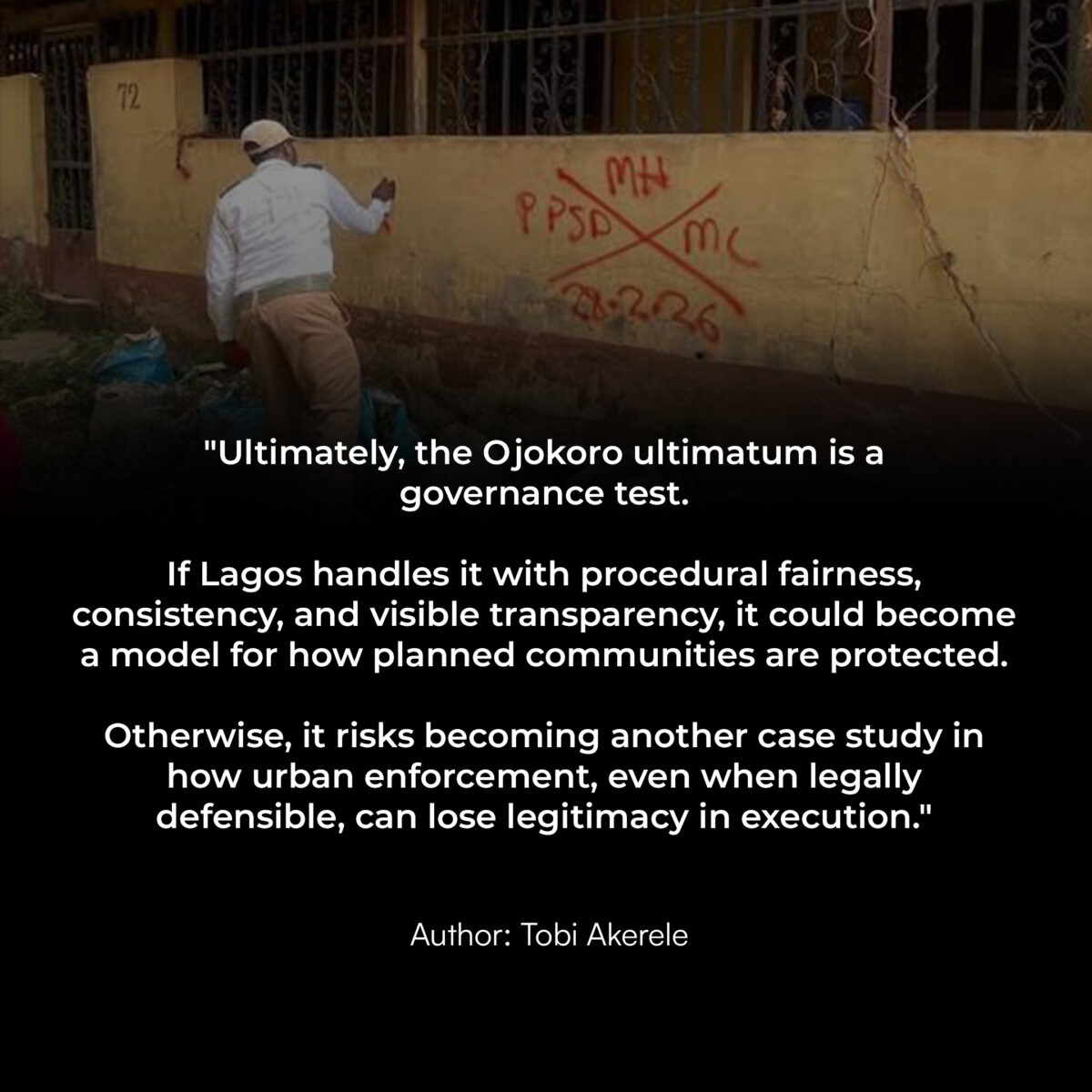
Ultimately, the Ojokoro ultimatum is a governance test.
If Lagos handles it with procedural fairness, consistency, and visible transparency, it could become a model for how planned communities are protected. Otherwise, it risks becoming another case study in how urban enforcement, even when legally defensible, can lose legitimacy in execution.