


When GIDI Real Estate Investment Limited selected Cairo and Sharm El Sheikh as the destination for GIDI Intra-Africa Realtors’ Conference 4.0, the decision went beyond location. It defined the framework of engagement.
This year’s conference effectively stages Africa’s “real estate stress test” across two distinct but complementary markets: Cairo’s developer-financed megaproject ecosystem and Sharm El Sheikh’s tourism-priced resort economy.
The significance lies in Egypt’s recent macroeconomic trajectory. Over the past 24 months, the country has demonstrated how an African market can operate under foreign exchange repricing, double-digit inflation, and high interest rates, yet continue to attract capital, close transactions, and deliver supply, where financing structures and demand drivers are aligned.
This is precisely the problem set GIDI IARC seeks to address: cross-border collaboration, investment matchmaking, skills transfer, and policy dialogue aimed at reducing friction and raising standards across Africa’s real estate value chain.
The conference itself is positioned as a platform to convene industry stakeholders and facilitate dialogue around key constraints, housing deficits, market coordination, and information asymmetry. Its emphasis on affordable housing and capacity building reflects a deliberate shift from pure deal promotion to institutional development.
These themes, investment, scalability, and trust infrastructure (transparency, accountability, and data integrity), are not abstract in Egypt. They are embedded in real-time market behavior.
Egypt’s macroeconomic reset provides the context. According to the International Monetary Fund, real GDP growth has recovered to 4.4% in FY2024/25, inflation declined to 11.9% in January 2026, and reserves increased from $54.9 billion in December 2024 to $59.2 billion in December 2025, despite persistent geopolitical risks.
However, monetary conditions remain restrictive, with policy rates held at 19% (deposit) and 20% (lending). This environment suppresses traditional mortgage depth and shifts the burden of financing to alternative structures.
In Cairo, that gap is filled by developer-led credit systems. Developers now offer buyer-friendly terms, with low down payments and extended installment periods, effectively creating an internal financing market that sustains transaction activity even when bank credit is expensive.
Pricing behavior reflects broader macro pressures. Market updates indicate that both sales and rental values are closely aligned with inflation trends, with notable increases across key districts. In the commercial segment, limited availability of prime office space has put upward pressure on rates, reinforcing a quality-flight dynamic typical of high-uncertainty markets.
At the upper end of the market, foreign capital continues to play a defining role. Large-scale transactions, such as the ADQ-led Ras El Hekma development, serve as confidence anchors and signal sustained investor appetite for hard assets within Egypt’s real estate ecosystem.
Sharm El Sheikh, on the other hand, presents a different but equally relevant model. Its property market is fundamentally tied to tourism throughput, where hotel performance indicators serve as more reliable pricing signals than fragmented residential data.
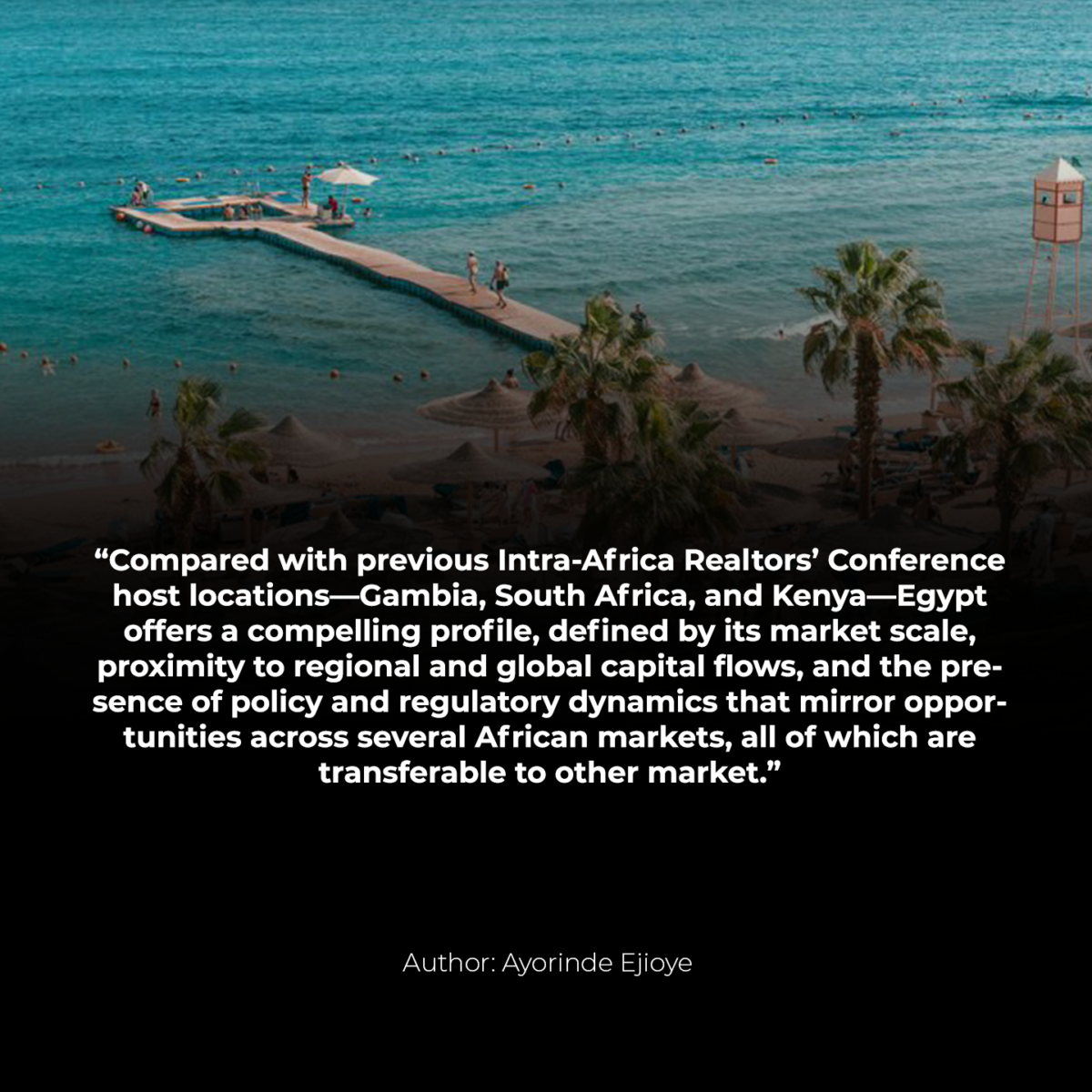
Against this backdrop, hosting GIDI IARC in Cairo and Sharm offers a strategic advantage over previous locations. Unlike past editions in Gambia, South Africa, and Kenya, Egypt combines market scale, capital adjacency, and policy complexity in a way that is directly transferable to other African markets.
At the same time, Egypt presents a nuanced regulatory environment that balances openness to investment with strategic constraints. This duality creates a practical setting for policy dialogue on investor protection, national security considerations, and deal structuring factors that often determine whether intra-African transactions materialize.
For conference participants, investors must refine their approach to pricing risk, distinguishing between nominal growth and real value. Developers must balance demand expansion with delivery credibility and financial sustainability. Policymakers are challenged to deepen mortgage markets without destabilizing inflation, while brokers must elevate professional standards to meet the demands of cross-border transactions.
In this context, GIDI IARC 4.0 is a working model for how Africa’s real estate markets can be understood, structured, and advanced.