


Productive Economic Input as the True Measure of Real Estate Growth in Nigeria
Real estate growth in Nigeria is often discussed through the language of rising land prices, premium locations, fast-selling estates, and impressive project launches. These are important indicators, but they do not tell the full story. A market can record rising property values and still fail to contribute meaningfully to the wider economy if those values are not supported by data, structure, productivity, and access.
This is one of the biggest questions facing Nigeria’s real estate sector today. How much of the value we celebrate is truly productive, and how much of it is simply nominal value created by scarcity, speculation, weak market intelligence, and hype?
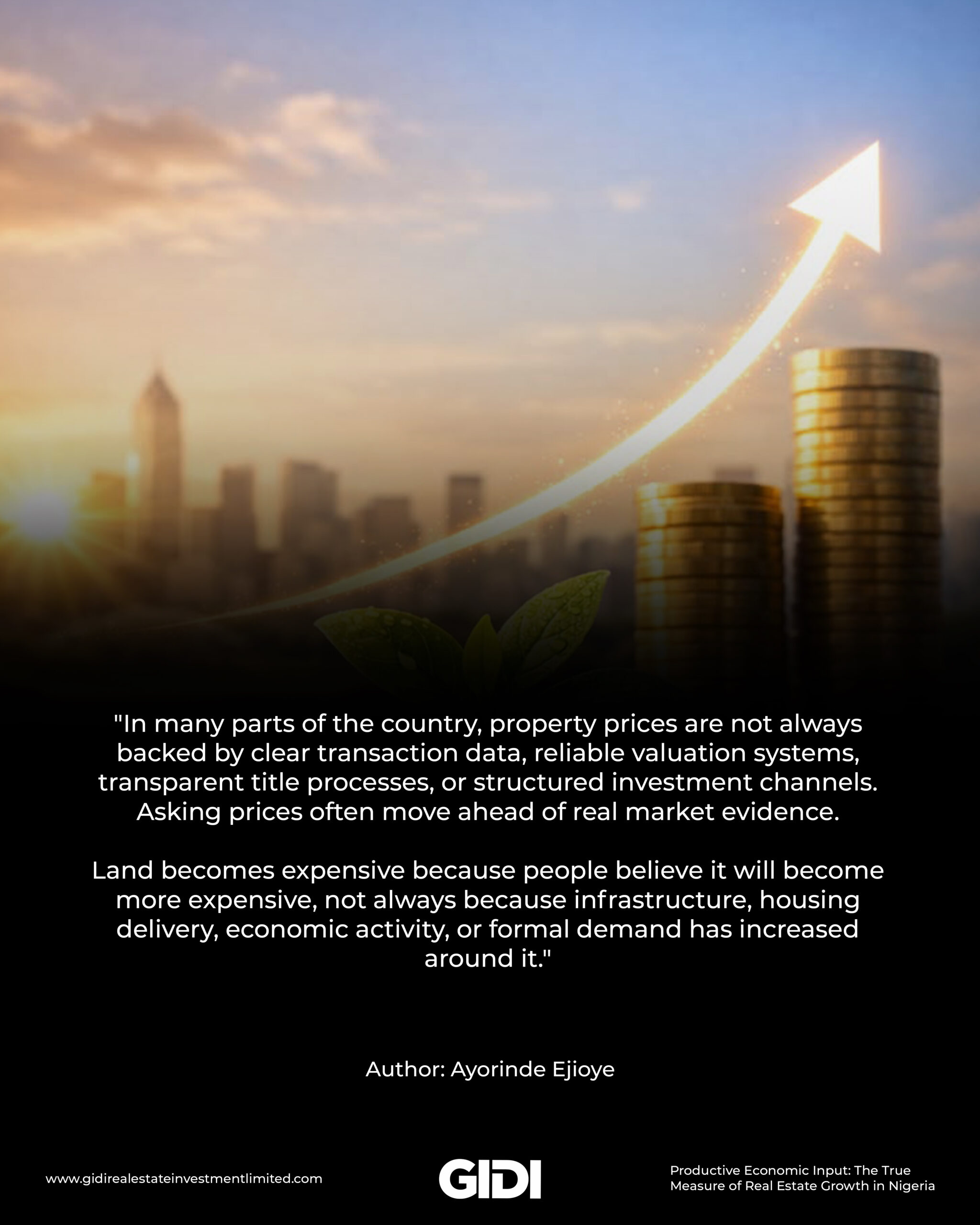
In many parts of the country, property prices are not always backed by clear transaction data, reliable valuation systems, transparent title processes, or structured investment channels. Asking prices often move ahead of real market evidence. Land becomes expensive because people believe it will become more expensive, not always because infrastructure, housing delivery, economic activity, or formal demand has increased around it.
This creates a dangerous weakness. Real estate becomes a store of value, but not necessarily a productive economic engine. People buy land and hold it. Developers price ahead of delivery. Buyers struggle to verify value. Realtors sell narratives without sufficient data. The government loses revenue to informal transactions. The economy gets only a fraction of the value that a well-structured property market should provide.
The result is visible in the market. Nigeria still faces major housing deficits. Construction costs remain high. Rent continues to rise faster than income in many urban centers. Malpractices thrive where information is weak. Speculation replaces planning. In such an environment, real estate may look active on the surface, but its economic input remains limited.
For real estate to contribute meaningfully to national development, the sector must move from nominal value to productive value. A productive real estate market is not measured only by how much land appreciates. It is measured by the number of homes delivered, the jobs created, the roads opened, the communities built, the mortgages enabled, the construction supply chains supported, and the quality of life improved.
When an estate is properly planned and delivered, it does more than transfer land from one owner to another. It engages surveyors, architects, engineers, builders, artisans, lawyers, financiers, marketers, facility managers, and local suppliers. It creates demand for cement, steel, wood, labor, logistics, fittings, security, power, water, and retail services. It opens up new corridors and improves surrounding commercial activity. That is real economic input.
Every stakeholder has a role to play. The government must improve land administration, title processing, planning approvals, infrastructure delivery, and market data. Developers must build with stronger discipline, clearer timelines, realistic pricing, and products that respond to actual housing and commercial needs. Financial institutions must deepen mortgage access and long-term project finance. Realtors and professionals must move beyond hype and support the market with verified information. Investors must also begin to ask better questions, not only about appreciation but about utility, infrastructure, documentation, and long-term demand.
Nigeria stands to benefit greatly from a tighter, more transparent, and more productive real estate sector. Real estate can support jobs, expand cities, deepen household wealth, attract investment, and strengthen the non-oil economy. But this will only happen when the market becomes less dependent on inefficiencies and more committed to measurable value creation.
The future of Nigerian real estate should not be judged by price movement alone. It should be judged by what the sector produces for people, communities, businesses, and the economy. That is the true measure of growth.
Author: Ayorinde Ejioye
Chief Operating Officer (COO), Gidi Real Estate Investment Limited