



1. PropTech Capital Flows Signal Maturing African Real Estate Systems
A Moroccan PropTech firm, Yakeey, secured $15 million in Series A funding, reinforcing a broader continental trend: capital is increasingly flowing toward platforms that improve transparency, transaction efficiency, and data reliability in property markets. This reflects growing investor preference for infrastructure-grade real estate systems rather than just physical assets.
Why this matters to the sector
Indicates growing institutional comfort with African real estate systems, not just assets
Highlights technology as a risk-mitigation and trust-building layer in property transactions.
Signals that markets with clearer data and processes will attract capital faster
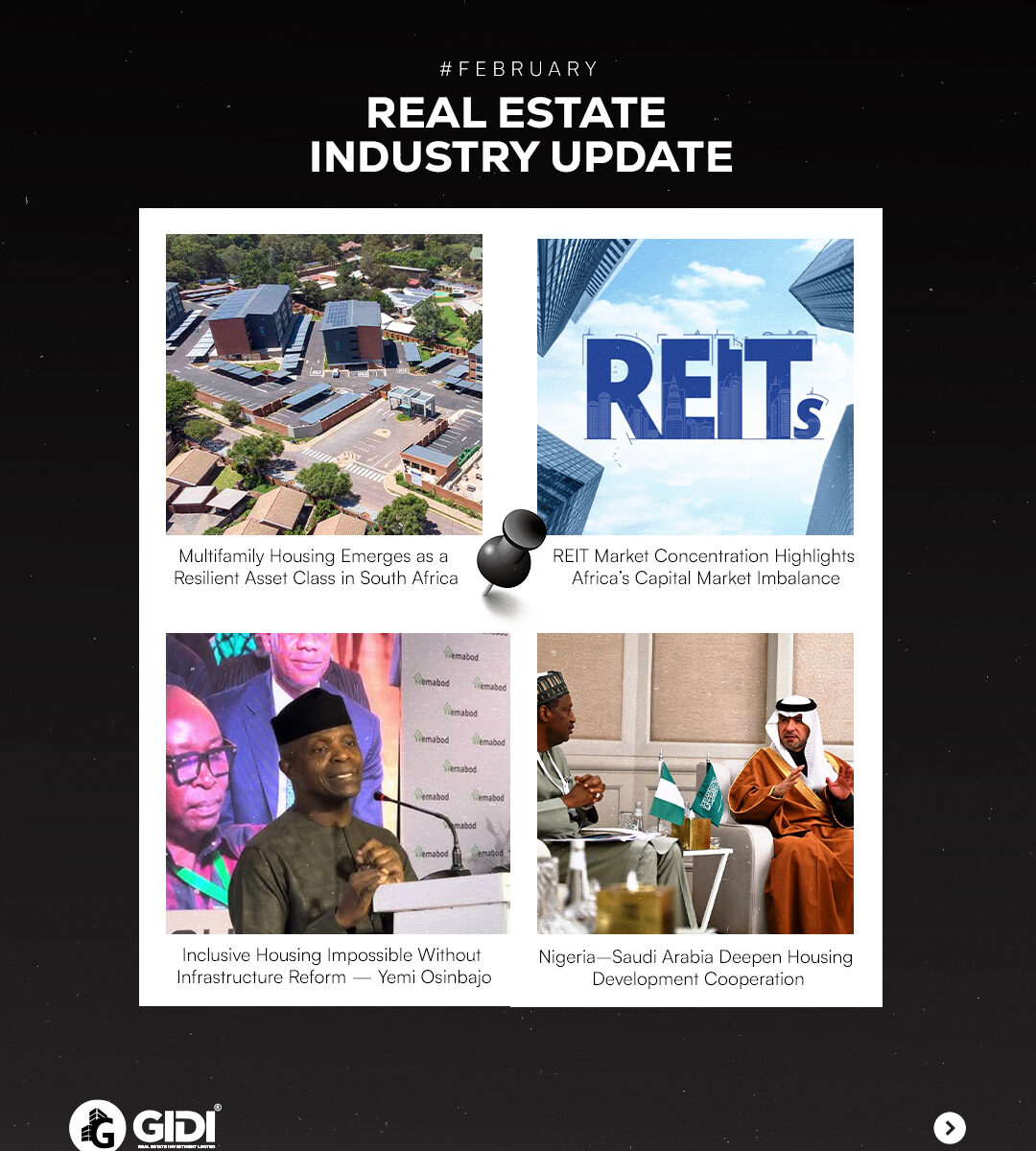
2. Multifamily Housing Emerges as a Resilient Asset Class in South Africa
South Africa continues to attract institutional capital into multifamily residential assets, driven by stable rental demand and predictable cash flows. The trend reinforces a pan-African shift toward income-producing residential real estate, especially in urban centers facing affordability pressures.
Why this matters to the sector
Reinforces rental housing as a defensive, income-generating class.
Demonstrates investor preference for cash-flow stability and appreciation.
Provides a benchmark for African markets facing affordability constraints.
3. REIT Market Concentration Highlights Africa’s Capital Market Imbalance
South Africa still controls over 95% of Africa’s REIT market, exposing a structural gap in institutional real estate financing across the continent. While markets like Nigeria show growing interest, regulatory depth, liquidity, and investor confidence remain decisive differentiators.
Why this matters to the sector
Reveals where long-term capital is structurally enabled
Underscores the importance of regulatory clarity, liquidity, and governance.
Highlights missed opportunities in markets like Nigeria due to weak frameworks.
NG NIGERIA | Policy, Finance & Partnerships
1. Tax Reform and Mortgage Access to Define 2026 Real Trajectory
Industry stakeholders agree that tax clarity and improved mortgage accessibility will be central to Nigeria’s real estate growth in 2026. Reforms in these areas are expected to influence housing affordability, developer confidence, and investor participation across income segments.
Why this matters to the sector
Directly affects housing affordability and buyer participation
Influences developer pricing, margins, and project feasibility
Signals a shift from cash-driven markets to structured housing finance systems
2. Inclusive Housing Impossible Without Infrastructure Reform — Yemi Osinbajo
At a national housing forum, Osinbajo stressed that housing delivery cannot succeed without coordinated infrastructure planning, land governance reform, and strong public-private partnerships. The emphasis was on sequencing infrastructure before mass housing delivery.
Why this matters to the sector
Reframes housing as an ecosystem challenge, not a construction problem
Align housing delivery with transport, utilities, and urban planning
Encourages developers to prioritize infrastructure-ready locations.
3. Nigeria and Saudi Arabia Deepen Housing Development Cooperation
Nigeria and Saudi Arabia agreed to expand cooperation on large-scale housing delivery, construction technology transfer, and financing models at the 2026 Real Estate Future Forum. The partnership aligns with Nigeria’s push to attract foreign capital into housing and construction.
Why this matters to the sector
Opens pathways for foreign capital and technical expertise.
Supports local construction capacity and material development.
Signals growing international confidence in Nigeria’s housing agenda
LAGOS | Infrastructure, Supply & Market Reality
1. Infrastructure Remains the Primary Driver of Real Estate Growth — Babajide Sanwo-Olu
The Lagos State Governor reaffirmed that transport, utilities, and urban infrastructure are the backbone of real estate and economic growth, signaling where value creation and development momentum will concentrate.
Why this matters to the sector
Confirms that infrastructure-led locations will outperform speculative zones
Guides developers and investors on where long-term value is concentrated.
Reinforce the need for alignment with government development priorities
2. Housing Supply Lags Despite Over 34,800 Units in the Pipeline
Recent data shows that although thousands of housing units are under construction, Lagos remains structurally undersupplied, given population growth and urban migration. Demand continues to outpace delivery, especially in affordable and mid-market segments.
Why this matters to the sector
Highlights the persistent demand-supply imbalance
Explains the pressure on prices and rents to go upward
Emphasizes the opportunity in scale, affordability, and delivery efficiency.
3. Industry Push to Unlock Dormant Land Assets
Real estate stakeholders at Lagos market forums are calling for land activation policies.
improved titling efficiency, and public-private collaboration to translate infrastructure investment into real housing output.
Why this matters to the sector
Links land reform directly to housing affordability
Encourages collaboration between the government and private developers
Positions land governance as a critical bottleneck to growth
4. Infrastructure-Led Corridors to Shape Property Values in 2026
Market consensus indicates that infrastructure-aligned corridors, rather than speculative zones, will dictate property value appreciation and investment flows across Lagos this year.
Why this matters to the sector
Provides a clear investment lensfor 2026
Reduce speculative risk by anchoring decisions in infrastructure reality
Helps stakeholders anticipate future growth nodes in Lagos.