


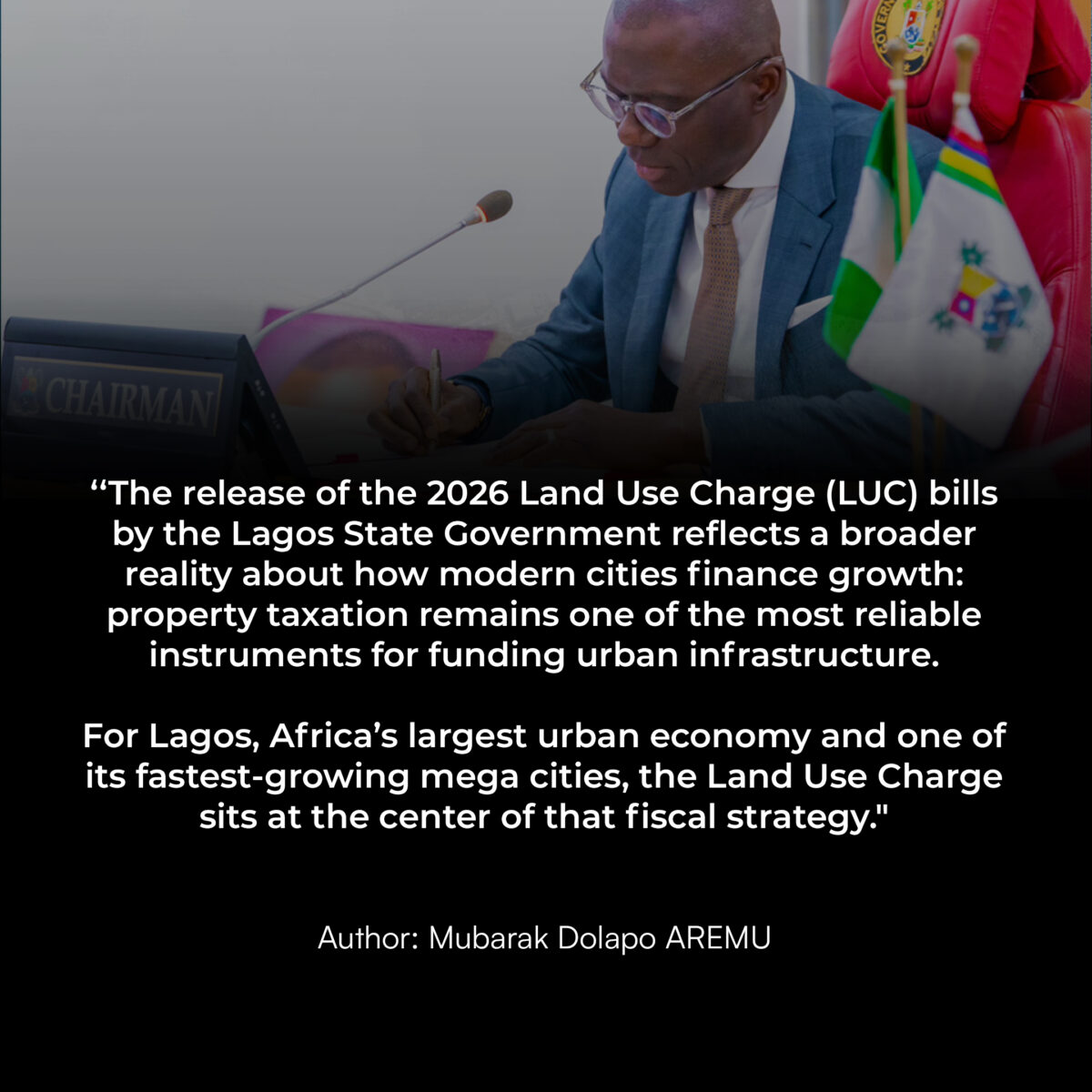
The Lagos State Government’s release of the 2026 Land Use Charge (LUC) bills reflects a broader reality: property taxation remains one of the most reliable instruments for funding urban infrastructure.
For Lagos, Africa’s largest urban economy and one of its fastest-growing megacities, the Land Use Charge sits at the center of that fiscal strategy.
Introduced under the Lagos State Land Use Charge Law, the policy consolidated multiple property-related taxes, ground rent, tenement rate, and neighborhood improvement levy into a single annual charge on property ownership.
In principle, the reform simplified the tax framework while expanding the state’s internally generated revenue base.
In practice, it has become one of the most consequential fiscal instruments shaping the economics of property ownership in Lagos.
The government’s 2026 announcement carries two immediate signals. First, property owners are encouraged to take advantage of a 15% early payment discount, a policy designed to accelerate compliance and improve cash flow for public spending.
Second, enforcement measures against 2025 defaulters are expected to begin shortly, reinforcing the administration’s push for stricter tax compliance across the state’s expanding property base.
Behind the policy lies a simple economic logic: property taxes anchor the financial sustainability of cities. The Lagos government consistently frames the Land Use Charge as a mechanism for funding infrastructure such as roads, healthcare facilities, schools, and security systems.
Revenues are also linked to large-scale transport investments such as the Lagos Rail Mass Transit Blue Line and Red Line, projects intended to improve mobility across the metropolitan region and reduce the cost of urban congestion.
In structural terms, the land use charge functions as Lagos’ primary property tax. Charges are typically calculated using an assessed property value combined with a rate determined by the property’s use, owner-occupied residential, commercial, or industrial. Commercial assets generally attract higher rates due to their income-generating potential, while residential homes, particularly owner-occupied ones, fall within lower tax brackets.
Yet the policy remains one of the most debated aspects of Lagos’ real estate environment. Property owners often challenge the assessment methodology, arguing that valuations can exceed realistic market conditions.
Landlords also point to the indirect effect on housing costs: as tax obligations increase, the burden can cascade through higher rents or service charges.
The debate reflects a deeper tension common to rapidly urbanizing cities. Lagos faces intense demand for infrastructure while simultaneously experiencing one of Africa’s fastest rates of population growth.
Property taxation, therefore, becomes both a fiscal necessity and a political balancing act, requiring the government to fund public services without undermining the affordability or attractiveness of property investment.
For developers and investors, the Land Use Charge has become a structural cost embedded in the economics of real estate projects. Investors increasingly factor annual LUC obligations into property valuations, rental projections, and long-term yield calculations.
High-value districts such as Ikoyi and Victoria Island can attract substantial annual charges due to their premium land values, reinforcing the importance of tax planning in property investment decisions.
The government has also expanded payment channels to improve compliance, allowing property owners to settle their obligations through bank transfers, USSD payments, point-of-sale terminals, the Lagos Online Assistant (LOLA), and the Lagos Revenue Portal.
The digitization of tax collection reflects Lagos’s broader attempt to modernize its revenue administration as the city grows in scale and complexity.
Ultimately, the Land Use Charge illustrates how property markets and public finance intersect. As Lagos expands into a globally competitive megacity under the leadership of Babajide Olusola Sanwo-Olu, the fiscal role of property taxation is likely to deepen rather than diminish.
The challenge lies in maintaining a balance where compliance strengthens public infrastructure while preserving the incentives that continue to attract investment into the city’s rapidly evolving real estate landscape.
In that sense, the Land Use Charge should be viewed less as a temporary fiscal measure and more as part of Lagos’ long-term urban governance architecture, one that ties the value of property ownership directly to the financing of the city itself.